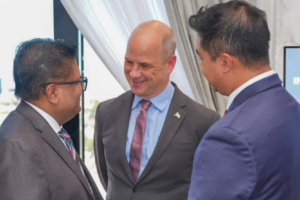
Jagdeo Calls for Global Action on Biodiversity Financing, Warns Against Penalizing Countries That Protect Their Forests

GEORGETOWN, GUYANA | October 31, 2026
Vice President Dr Bharrat Jagdeo has called for renewed international efforts to finance biodiversity conservation, warning that inadequate funding, uncertainty surrounding biodiversity credits and changing global priorities are threatening progress toward environmental protection commitments.
Addressing the Second Global Biodiversity Alliance (GBA) Conference at the Arthur Chung Conference Centre on Friday, October 30, Jagdeo urged the organization to concentrate on supporting the objectives of the United Nations Convention on Biological Diversity (CBD) rather than developing a competing framework of targets.
The vice president said the Alliance, which has expanded from 17 to 142 members, should use its growing international network to strengthen technical cooperation, support global negotiations and accelerate practical conservation initiatives.
“The alliance cannot supplant the UN Convention on Biodiversity. That’s a point we need to make right up front,” Jagdeo told delegates.
His remarks followed what he described as a disappointing outcome at the recent COP17 biodiversity conference in Armenia, which he said underscored the need to restore international urgency around nature conservation and financing.
Jagdeo identified three major challenges confronting biodiversity financing: the absence of an established compliance market or substantial voluntary market for biodiversity credits, insufficient public funding and continued disagreement over how biodiversity credits should be defined and measured.
He pointed to an estimated US$700 billion financing gap, arguing that existing financial commitments remain far below the resources required to meet global biodiversity objectives.
“We need to go back to establish a sense of urgency,” the vice president said.
Jagdeo outlined four priorities for the Alliance, including keeping biodiversity on international policy agendas despite competing concerns over energy costs, food security and geopolitical conflicts. He also called for stronger technical support for negotiators, protection of existing environmental commitments and the development of practical conservation models that can be replicated internationally.
Drawing on his involvement in Project Catalyst’s climate finance working group ahead of the 2009 Copenhagen climate negotiations, Jagdeo said detailed technical analysis had helped establish the economic value of forest carbon as a means of reducing emissions.
He suggested that a similar approach could help resolve outstanding questions about biodiversity credits, including how conservation outcomes should be measured, verified and financed.
“So I think that we need to get back to quiet work,” he said, proposing specialized working groups to address the technical and financial uncertainties surrounding emerging biodiversity markets.
The vice president also raised concerns about proposals that could disadvantage countries maintaining extensive forest cover and historically low deforestation rates.
According to Jagdeo, some European policy discussions have suggested that high-forest, low-deforestation countries such as Guyana should receive less compensation than countries undertaking reforestation after previously clearing substantial areas of forest.
He argued that such an approach could create incentives that favour restoration over the continued protection of intact forests, potentially undermining conservation efforts in countries that have maintained their natural ecosystems.
Jagdeo pointed to Guyana’s Low Carbon Development Strategy (LCDS) as an example of efforts to connect environmental protection with economic development and community investment.
He reported that more than 3,000 projects have been completed across 252 Indigenous villages using approximately 20 per cent of LCDS funding, while the remaining 80 per cent supports climate adaptation and other national initiatives.
Among the infrastructure works cited were approximately 840 kilometres of canals and 125 kilometres of embankments, which the government identifies as part of its efforts to strengthen resilience against flooding and other climate-related risks.
The vice president also addressed the environmental challenges associated with Guyana’s rapidly expanding economy, particularly the growth of the oil and gas industry, rising electricity consumption and increased vehicle imports.
He said national electricity demand has increased by approximately 25 per cent over the past two years, while annual vehicle imports are estimated at 40,000.
Despite these pressures, Jagdeo maintained that Guyana remains committed to environmental safeguards, including its policy against routine gas flaring, taxation of scheduled flaring and a target to protect 30 percent of its territory by 2030.
The government’s environmental commitments continue alongside the expansion of petroleum production, placing attention on how economic growth, emissions management and biodiversity conservation are balanced in practice.
Jagdeo said Guyana intends to maintain its environmental policies while encouraging other countries and international institutions to strengthen their commitments to conservation financing.
“We can pledge to you that we will remain firmly in favour of strong environmental stewardship here and globally,” he stated.
The conference brought together international participants to examine biodiversity financing, conservation partnerships and the role of governments, research institutions and financial organizations in supporting environmental protection.
Jagdeo’s proposals place particular emphasis on strengthening existing international agreements, resolving uncertainties surrounding biodiversity credits and developing financing arrangements that recognize the value of protecting forests before they are destroyed.

STAFF WRITER
Senior journalist and investigative reporter for NewsGuyana24 covering national affairs, energy governance, and Caribbean diplomacy.
View All Articles By STAFF WRITER →